Take some time each day to unplug and think without distractions.
In Quiet Time, Part 1, I set the stage for why taking time each day is important. Here are some different ways you can unplug for a little while every day.
Get back to nature
Get up from your desk and take a walk around your block or your neighborhood. Leave your ear buds at home and your phone in your pocket. This is a not a walk for exercise, but just to let give your mind time to wander and make subconscious connections. I find that taking a thinking walk is extremely useful when I am wrestling with some problem or need time to compose a response to an e-mail.
Flipped Classroom Teaching on YouTube advocates this approach for teachers to help students process learning.
Exercise
The gym that I visit to workout has large televisions prominently displayed for viewing from almost any position. Each of the treadmill and elliptical machines each feature their own small televisions; they also include a small shelf to place your smart phone. There have been times that I watched something on the television with the sound muted while listening to music on my iPhone.
However, more recently I have committed working out without watching television or listening to music. Like the thinking walk, exercising provides an excellent opportunity to increase the oxygen flow to your brain while providing a space for problem-solving.
Take a shower
The advantage of taking a shower or bath, or swimming in a pool, is that electronics and water do not mix. Thus, you must be disconnected in order to be in water. While more BlueTooth, waterproof speakers are available, I encourage you to take silent showers in order, once again, to provide your mind some time to process your studies, writing, or work.
Take a nap
I once read a book that described a technique used by Thomas Jefferson to discover new ideas. According to the book, Jefferson would sit in a chair while holding a metal ball in each hand. As he drifted off to sleep, the ball would drop from his hands into a metal pie plate; the noise would startle him awake. Whatever Jefferson was dreaming when startled is what he would evaluate for future development.
Even if you don't go to the effort that Jefferson did, simply taking a nap can renew your energy and provide a break for mental processing.
I encourage you to try one of these techniques to see if it improves whatever it is that you are working on. What other ways have you tried to achieve some quiet time?
Showing posts with label change. Show all posts
Monday, January 11, 2016
Friday, November 6, 2015
30-day challenges to challenge you
Complete a 30-day challenge and change your life. This list provides 12 possibilities in the areas of spiritual, physical, emotional, and learning.
It seems like there are a variety of 30-day challenges to introduce you to new ways of doing things.
▶️ Be intentional with your time
▶️ Give consistent, daily effort
▶️ Set goals
▶️ Track your progress
▶️ Reward desired behavior
Below are twelve challenges that I have either completed or would like to attempt at some point in the future. These challenges span the four main aspects of life: spiritual, social, mental, and physical. Each of these challenges should be done every day for thirty days. If for some reason you miss a day, don't give up; start back as soon as you can.
Challenges completed for 30 consecutive days are meant to challenge you. Select one of these challenges that may be a new activity. Commit to doing it every day for the next 30 days.
1. Write 500 words. You can write about anything, but the key is to write without editing - just write. I learned about a writing challenge, My 500 Words, from the author Jeff Goins. I started this challenge in January, 2015. Somehow I reinterpreted the challenge as writing 500 words per day for 120 days, so I ended up writing over 60,000 words.
2. Write out a Psalm. I completed this challenge in 2012. I wrote out (by hand) a Psalm from the Bible every day. The Psalms are a good source because they are inspirational, usually short, and there is a large variety from which to choose. I selected the Psalms prior to starting the challenge.
3. Complete a 30-day plank challenge. The planking exercise consists of holding your body stiff while resting on your forearms. You can read more about the planking challenge at 30 Day Fitness Challenges.
4. Take a photo every day and upload it to Instagram or Tumblr. Most of us probably think of Instagram as a place to upload pics and write a brief caption. However, I have seen more and more posts with long descriptions and stories. Read about this approach at Nieman Storyboard. Three excellent sites for photo challenge ideas are: FatMumSlim, Expert Photography, and The Idea Room.
5. Create a video every day and upload it to YouTube. I learned about this via e-mail from one of the many entrepreneurs I subscribe to. Many tips are provided on the 30 Day Video Challenge, but you don't have to join ($177.00) in order to benefit.
6. Read the Bible for fifteen minutes. If you are not familiar with the Bible, start reading at Psalms or Acts. Beyond physical Bibles with pages, numerous apps exist that feature a variety of translations and features.
7. Drink only water. The Mayo Clinic recommends about 3 liters of total liquids per day for men and 2.2 liters for women. A number of variations exist, ranging from the classic 8 cups (64 ounces) per day to calculations based on weight. The key for this challenge is that you should only drink water: no tea, coffee, juice, or alcohol.
8. Do a random act of kindness. Reaching out to help others also helps us individually. For this challenge, be aware of the activities going on around you and find a way every day to ease someone's burden, whether that is holding the door open or giving up your parking space or feeding the homeless. The Random Acts of Kindness Foundation has a great list to give you some ideas.
9. Learn a new word. Increase your vocabulary by learning a new word or phrase every day. The Merriam-Webster dictionary, both online and the app, feature a word of the day. For maximum learning to occur, write out the definition of the word.
10. Memorize a Bible verse that is new to you. There are many promises, inspirational passages, and guidance for life in the Bible. Search for some of these yourself or start with an online list.
11. Single-task at your desk. The opposite of multi-tasking, which scientists suggest is really a misnomer, single tasking means doing one thing at a time. Clear everything from your desk except the barest of essentials: a computer, if needed, a planner, and writing utensils. Bring out whatever resources you need to accomplish a task, but then clear those resources before starting the next task.
12. Walk 15 to 20 minutes. If you don't have a regular exercise program, this is a great start. Beyond the benefits of physical exercise, gives you an opportunity to stimulate your brain for better thinking and lets you take a mental relaxation break. Stepping away from a problem may provide a catalyst for problem solving.
Create a record in a journal, on a whiteboard, or on your computer so that you can track your progress every day. At a minimum, record whether or not you completed the challenge each day. If the challenge is quantifiable (e.g, minutes or distance walked, number of words written, ounces of water consumed), record these measurements as well. This will allow you to review your progress and see what is possible in a brief period of time.
Have you started any 30-day challenges? Have you completed any 30-day challenges? What helps you get from the start to the finish?
Yes, I commit to a 30-day challenge!
It seems like there are a variety of 30-day challenges to introduce you to new ways of doing things.
Advantages of a 30-day challenge
A 30-day challenge of any kind has several advantages.- Thirty days is enough time for something to potentially become a habit.
- Thirty days is not a life time, so you can try a challenge and discontinue it after the 30 days, if desired.
- Engaging in an activity every day for a certain number of days achieves approaches to life that I advocate:
▶️ Be intentional with your time
▶️ Give consistent, daily effort
▶️ Set goals
▶️ Track your progress
▶️ Reward desired behavior
Below are twelve challenges that I have either completed or would like to attempt at some point in the future. These challenges span the four main aspects of life: spiritual, social, mental, and physical. Each of these challenges should be done every day for thirty days. If for some reason you miss a day, don't give up; start back as soon as you can.
Challenges completed for 30 consecutive days are meant to challenge you. Select one of these challenges that may be a new activity. Commit to doing it every day for the next 30 days.
Twelve 30-day challenges
1. Write 500 words. You can write about anything, but the key is to write without editing - just write. I learned about a writing challenge, My 500 Words, from the author Jeff Goins. I started this challenge in January, 2015. Somehow I reinterpreted the challenge as writing 500 words per day for 120 days, so I ended up writing over 60,000 words.
2. Write out a Psalm. I completed this challenge in 2012. I wrote out (by hand) a Psalm from the Bible every day. The Psalms are a good source because they are inspirational, usually short, and there is a large variety from which to choose. I selected the Psalms prior to starting the challenge.
3. Complete a 30-day plank challenge. The planking exercise consists of holding your body stiff while resting on your forearms. You can read more about the planking challenge at 30 Day Fitness Challenges.
4. Take a photo every day and upload it to Instagram or Tumblr. Most of us probably think of Instagram as a place to upload pics and write a brief caption. However, I have seen more and more posts with long descriptions and stories. Read about this approach at Nieman Storyboard. Three excellent sites for photo challenge ideas are: FatMumSlim, Expert Photography, and The Idea Room.
5. Create a video every day and upload it to YouTube. I learned about this via e-mail from one of the many entrepreneurs I subscribe to. Many tips are provided on the 30 Day Video Challenge, but you don't have to join ($177.00) in order to benefit.
6. Read the Bible for fifteen minutes. If you are not familiar with the Bible, start reading at Psalms or Acts. Beyond physical Bibles with pages, numerous apps exist that feature a variety of translations and features.
7. Drink only water. The Mayo Clinic recommends about 3 liters of total liquids per day for men and 2.2 liters for women. A number of variations exist, ranging from the classic 8 cups (64 ounces) per day to calculations based on weight. The key for this challenge is that you should only drink water: no tea, coffee, juice, or alcohol.
8. Do a random act of kindness. Reaching out to help others also helps us individually. For this challenge, be aware of the activities going on around you and find a way every day to ease someone's burden, whether that is holding the door open or giving up your parking space or feeding the homeless. The Random Acts of Kindness Foundation has a great list to give you some ideas.
9. Learn a new word. Increase your vocabulary by learning a new word or phrase every day. The Merriam-Webster dictionary, both online and the app, feature a word of the day. For maximum learning to occur, write out the definition of the word.
10. Memorize a Bible verse that is new to you. There are many promises, inspirational passages, and guidance for life in the Bible. Search for some of these yourself or start with an online list.
11. Single-task at your desk. The opposite of multi-tasking, which scientists suggest is really a misnomer, single tasking means doing one thing at a time. Clear everything from your desk except the barest of essentials: a computer, if needed, a planner, and writing utensils. Bring out whatever resources you need to accomplish a task, but then clear those resources before starting the next task.
12. Walk 15 to 20 minutes. If you don't have a regular exercise program, this is a great start. Beyond the benefits of physical exercise, gives you an opportunity to stimulate your brain for better thinking and lets you take a mental relaxation break. Stepping away from a problem may provide a catalyst for problem solving.
Create a record in a journal, on a whiteboard, or on your computer so that you can track your progress every day. At a minimum, record whether or not you completed the challenge each day. If the challenge is quantifiable (e.g, minutes or distance walked, number of words written, ounces of water consumed), record these measurements as well. This will allow you to review your progress and see what is possible in a brief period of time.
Have you started any 30-day challenges? Have you completed any 30-day challenges? What helps you get from the start to the finish?
Commit to a challenge
If you would like to commit to one of these challenges, use the link below to sign up. I will send you a couple of encouragements during the process and follow-up with you at the end.Yes, I commit to a 30-day challenge!
Never Quit Learning
If you learned something from this post, please check out my free e-book, Never Quit Learning: 10 easy ways knowledge can help you stand out.Tuesday, November 3, 2015
Reward Yourself
Use the science of behavior modification to motivate yourself.
If a behavior receives a positive reinforcement (for example, you give your dog a treat when he obeys a command) that behavior is more likely to be repeated. However, if you are punished when engaging in a certain behavior, theoretically, you may be less likely to repeat it. Research and history have both shown that punishment is largely ineffective in the long-term. Short-term, it may have some immediate effects, but usually those effects are brief. The table below depicts the conditions under which behavior is influenced.
Karen Pryor is an animal trainer and has worked with large marine mammals such as dolphins and orcas. In her book, Don't Shoot the Dog, she discusses the fact that whales do not accept punishment. If the mammal misses a trick and is given a punishment, the whale will no longer respond to the trainer.
I am not one of those exercising-loving individuals who runs until the endorphins kick in. However, I recognize the necessity of exercising for better health. To keep myself motivated to walk every day, I decided that I would celebrate each marathon, 26 miles, that I complete. At a rate of three to four miles per day, I am able to walk a marathon every few days. My incentive is $25 to spend at Amazon or iTunes. Now that I am walking consistently, I have changed my reinforcement structure so that I need to walk 50 miles in order to receive the reward.
In previous posts I wrote about my writing project where I wrote 60,000 words in six weeks. I gave myself incentives for completing blocks of words ahead of schedule. This was effective. My initial goal was to write 500 words per day for 120 days. However, by incentivizing my writing, I wanted to write more words per day and try to write regularly.
The Science
In the classic book, Science and Human Behavior, B. F. Skinner describes the behavioral principles that govern much of human and animal behavior. The premise of the book is that behavior is influenced by the consequence of the behavior.If a behavior receives a positive reinforcement (for example, you give your dog a treat when he obeys a command) that behavior is more likely to be repeated. However, if you are punished when engaging in a certain behavior, theoretically, you may be less likely to repeat it. Research and history have both shown that punishment is largely ineffective in the long-term. Short-term, it may have some immediate effects, but usually those effects are brief. The table below depicts the conditions under which behavior is influenced.
Karen Pryor is an animal trainer and has worked with large marine mammals such as dolphins and orcas. In her book, Don't Shoot the Dog, she discusses the fact that whales do not accept punishment. If the mammal misses a trick and is given a punishment, the whale will no longer respond to the trainer.
Create Incentives
Suppose you want to start an exercise program of some sort. Perhaps you want to walk or jog everyday or want to visit the local gym two to three times per week. You could provide an incentive by giving yourself a reinforcer when you complete a certain number of minutes or miles (walking/jogging) or number of visits to the fitness center.I am not one of those exercising-loving individuals who runs until the endorphins kick in. However, I recognize the necessity of exercising for better health. To keep myself motivated to walk every day, I decided that I would celebrate each marathon, 26 miles, that I complete. At a rate of three to four miles per day, I am able to walk a marathon every few days. My incentive is $25 to spend at Amazon or iTunes. Now that I am walking consistently, I have changed my reinforcement structure so that I need to walk 50 miles in order to receive the reward.
More Science - Schedules of Reinforcement
Another aspect of reinforcement is the schedule of reinforcement.- Fixed ratio reinforcement occurs when a reinforcer is administered after a certain specific number of responses, in my case miles walked.
- Fixed Interval reinforcement occurs when the reinforcer is given for the first response after a certain amount of time has elapsed. A example of this is salary paid every two weeks.
- Variable ratio reinforcement occurs when a reinforcer is administered after a random number of responses. For my exercise incentive program, I could randomly generate a number of miles. However, usually, the person receiving the reinforcement would not know what the random schedule is, something unavoidable when creating your own incentive plan. Variable ratio reinforcement is the secret behind slot machines. A random amount of money is given after a random number of attempts, thus ensuring that patrons sit mindlessly at the machines depositing coin after coin.
- Variable interval reinforcement, in which the first response is reinforced following a random amount of time, is effective when the person receiving the reinforcer doesn't know the schedule.
In previous posts I wrote about my writing project where I wrote 60,000 words in six weeks. I gave myself incentives for completing blocks of words ahead of schedule. This was effective. My initial goal was to write 500 words per day for 120 days. However, by incentivizing my writing, I wanted to write more words per day and try to write regularly.
Start Today
If you are trying to start a new behavior, think about about how you can provide incentives to help that behavior become a habit. Make a list of reinforcers and when you will earn them.Never Quit Learning
If you learned something from this post, please check out my free e-book, Never Quit Learning: 10 easy ways knowledge can help you stand out.Tuesday, August 4, 2015
Farewell Office Jet 4300
About ten years ago I walked into an office supply store in search of a new printer. Both of the inkjet printers I owned had stopped working, and I needed a replacement. As I walked through the aisles of all-in-one printers, single function inkjet printers, and laser jet printers, I was still unsure which model to select. I didn't want to invest a great deal of money, but wanted a printer that would last a few years.
Not feeling satisfied with the models available at the store, I walked towards the exit. That's when I saw the printer sales table. There was a brand new small, white printer, but for some reason on sale. It was listed for $50.00. The printer, a Hewlett Packard Office Jet 4300 turned to be an all-in-one printer with printing, faxing, copying, and scanning capabilities.
After Hewlett Packard stopped supporting the printer, I was no longer able to use it as a scanner. Faxing is not possible for me as I don't have a landline phone. Additionally, more recently, most printers have wireless capabilities, which allow printing from mobile devices as well as computers. For that reason, I decided, I would purchase a new printer when the ink cartridges ran out of ink. I began a relaxed search for a new printer.
Unfortunately, while in the middle of relocating my home office from the bonus room to vacant bedroom, I inadvertently knocked by printer off a tall dresser. After plummeting about four feet, the printer crashed to the floor, remaining in the location when photographed (see above picture).
I reconnected the printer. It cycled as though it would still work. However, although I heard the print heads moving as part of the initial power-up process, the printer displayed a jam message. Several times I tried to start the printer, each time with the same result.
After many years of excellent printing, I placed the printer in a bag for recycling. Office Jet 4300 served me well, and I definitely got my money's worth, at the tune of $0.42 per month, excluding printer cartridges, but that's another post.
Not feeling satisfied with the models available at the store, I walked towards the exit. That's when I saw the printer sales table. There was a brand new small, white printer, but for some reason on sale. It was listed for $50.00. The printer, a Hewlett Packard Office Jet 4300 turned to be an all-in-one printer with printing, faxing, copying, and scanning capabilities.
After Hewlett Packard stopped supporting the printer, I was no longer able to use it as a scanner. Faxing is not possible for me as I don't have a landline phone. Additionally, more recently, most printers have wireless capabilities, which allow printing from mobile devices as well as computers. For that reason, I decided, I would purchase a new printer when the ink cartridges ran out of ink. I began a relaxed search for a new printer.
Unfortunately, while in the middle of relocating my home office from the bonus room to vacant bedroom, I inadvertently knocked by printer off a tall dresser. After plummeting about four feet, the printer crashed to the floor, remaining in the location when photographed (see above picture).
I reconnected the printer. It cycled as though it would still work. However, although I heard the print heads moving as part of the initial power-up process, the printer displayed a jam message. Several times I tried to start the printer, each time with the same result.
After many years of excellent printing, I placed the printer in a bag for recycling. Office Jet 4300 served me well, and I definitely got my money's worth, at the tune of $0.42 per month, excluding printer cartridges, but that's another post.
Thursday, April 17, 2014
Create a run chart
Run charts are a type of line graph that depict measurements tracked over time. The two lines plotted on the chart are the actual measurements and the average or mean of the measurements. The average line is helpful to identify which measurements are above or below average. The average is also a quick way to compare the first set of collected information and what will be collected later (see Overview of Personal Quality Improvement).
In the last PQI post on collecting your first measurements, I wrote about recording some measurements over a period of 20-30 days. Once you have completed collected data, it is time to transfer information to a spreadsheet in order to calculate the average and then create a run chart.
SPREADSHEET SOFTWARE
Microsoft Excel was introduced in 1985 as a spreadsheet alternative to Lotus 1-2-3. Apple Numbers was introduced in 2007. Although Numbers doesn't have the powerful engine that Excel has in terms of formulas and complex data management, it does have the advantage of working across platforms. Numbers works seamlessly on iPhones, iPads, as well as Mac computers. A third, free alternative, is an online preadsheet program developed by Google. Google Spreadsheets has fairly extensive functionality and is accessed via the Internet. All of files are stored in Google Drive.
MY ITUNES PURCHASES
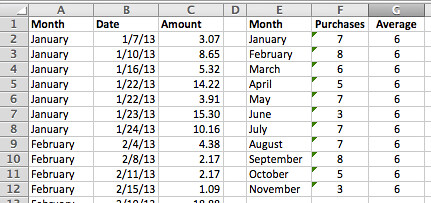
For the two charts below, I decided to use my iTunes purchased in 2013. I first downloaded a list of all of my iTunes purchases from January through November. After entering the data in columns A, B, and C, I used a couple of formulas to summarize the data by month (columns E, F, and G).
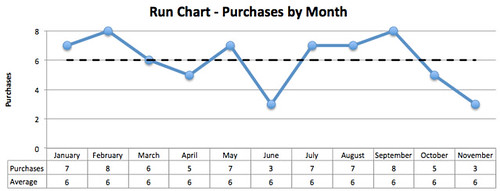
The "Purchases" (column F) shows counts of column A. In column G, "Averages," the number is simply the total number of purchases (from column F) divided by 11 months. Below is the resulting run chart:
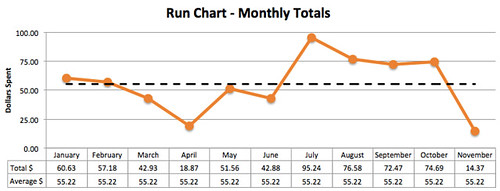
I also created a similar data set and run chart for the total amount spent per month.
In looking at these two charts, I can see that I spend more money than I would prefer on apps, music, and books from iTunes, and probably visit the store too often. In a later post, I will use this information to more closely analyze my iTunes purchases. For now, however, I accomplished my goal of objectively and simply transferring the data into a chart for a graphical view of the measurements.
If you collected data as discussed last month, it is now time to create your own run charts.
The link below will open a Google Spreadsheets file that you can save to you own Google Drive (free to setup and use). The first tab labeled "RunChartData" is the one you should select. The spreadsheet is currently populated with 30 sample data points. The average column is automatically calculated. The updated chart is displayed on the "RunChartGraph" tab.
Monday, April 7, 2014
PQI - Collect your first measurements
Last month I shared a post which described an overview the personal quality improvement plan, also known as PQI. In today's post, I will walk you through the steps to create or select a tracking log, decide on actions to track, and some tips to make collecting your measurements as easy as possible.
QUANTIFIED SELF
Quantified Self is a website and movement dedicated to "self knowledge through numbers." Followers of the this methodology rigorously collect all kinds of detail about themselves from how many hours they sleep, number of minutes exercising, routes walked from Point A to Point B, etc. Quantified Self chapters exist in many cities. When the members connect at gatherings, they share information on how to better collect information about themselves and discuss any insights they may have gained along the way.
FELTRON
Nick Feltron has been collecting his personal data and publishing in very artful ways for several years. He collects everything from number of photos taken to pages read to calendar entries, etc.
COLLECTED DATA VS. USED DATA
While Quantified Self members and Nick Feltron may enjoy some pleasure in collecting and sharing data, the journey for them seems to be about the process of collecting the data - not using the data collected for some purpose. The collection of measurements for PQI is different. The data that you collect will begin a journey of improvement.
HISTORY OF TRACKING DATA
For many years, therapists have routinely asked clients to track specific data about themselves (for example, the number of times relaxation exercises are done, the number of times you think about a specific object or person, or frequency of negative thoughts). Additionally, a routine part of assessments for attention deficit disorder in children is for parents and teachers to independently observe the child's behavior to determine the extent that the child is distracted in the classroom and at home.
CREATE A TRACKING LOG
The first step to collecting measurements is to create or select a tracking log. Once the tracking log is created, you will use it to keep a record of selected measurements for 25-30 consecutive days.
A small note book is ideal for record keeping. Additionally, you can use an app on your smartphone to record measurements. Another convenient way to track data is to create your own small booklet specifically designed for capturing measurements.
DIY Tracking Log
IDENTIFY AREAS TO TRACK
The second step is to identify areas to track. The following guidelines will help you select areas (known as variables) to track and record.
Examples of Variables
START TODAY
Following the instructions above, start tracking 3-4 variables today. If you take measurements every day, by the time I discuss how to summarize your data in next month's PQI posting, you will be ready to proceed.
QUANTIFIED SELF
Quantified Self is a website and movement dedicated to "self knowledge through numbers." Followers of the this methodology rigorously collect all kinds of detail about themselves from how many hours they sleep, number of minutes exercising, routes walked from Point A to Point B, etc. Quantified Self chapters exist in many cities. When the members connect at gatherings, they share information on how to better collect information about themselves and discuss any insights they may have gained along the way.
FELTRON
Nick Feltron has been collecting his personal data and publishing in very artful ways for several years. He collects everything from number of photos taken to pages read to calendar entries, etc.
COLLECTED DATA VS. USED DATA
While Quantified Self members and Nick Feltron may enjoy some pleasure in collecting and sharing data, the journey for them seems to be about the process of collecting the data - not using the data collected for some purpose. The collection of measurements for PQI is different. The data that you collect will begin a journey of improvement.
HISTORY OF TRACKING DATA
For many years, therapists have routinely asked clients to track specific data about themselves (for example, the number of times relaxation exercises are done, the number of times you think about a specific object or person, or frequency of negative thoughts). Additionally, a routine part of assessments for attention deficit disorder in children is for parents and teachers to independently observe the child's behavior to determine the extent that the child is distracted in the classroom and at home.
CREATE A TRACKING LOG
The first step to collecting measurements is to create or select a tracking log. Once the tracking log is created, you will use it to keep a record of selected measurements for 25-30 consecutive days.
A small note book is ideal for record keeping. Additionally, you can use an app on your smartphone to record measurements. Another convenient way to track data is to create your own small booklet specifically designed for capturing measurements.
DIY Tracking Log
- Take 4 sheets of 8.5-inch by 11-inch copy paper (blank), cut in half and in half again. The final size will be 4.25 x 5.5 inches.
- Using a file folder or card stock, cut out two covers with the same dimensions as the final paper size.
- Assemble the sheets between the file folder covers.
- Staple along the edge.
- The result is a book with 32 pages for entries.
IDENTIFY AREAS TO TRACK
The second step is to identify areas to track. The following guidelines will help you select areas (known as variables) to track and record.
- Select no more than 3-4 variables.
- What you are tracking must be under your control (e.g., money spent, minutes of exercise).
- Because there should be a minimum of 15-20 measurements per variable, select activities that occur every day or frequently. If you select something that occurs less frequently, you should keep recording until at least 15-20 measurements are collected.
- The areas you decide to track must be of interest to you.
- The areas must be measurable (quantifiable).
- Whatever you select must be easy to record without disruption. If you don't record actions as they occur, it is very likely that you will forget to record information later.
- Likewise, it should not take too much time to record measurements.
- Be honest with yourself and record accurately whatever you select.
Examples of Variables
| Variables to Count -calories -text messages -miles driven -sales visits | Time spent -reading -sleeping -exercising -video gaming | Money spent on -snacks -meals -entertainment -clothing | Categories/Yes-No -types of foods -meals at home -days exercising -days studying |
START TODAY
Following the instructions above, start tracking 3-4 variables today. If you take measurements every day, by the time I discuss how to summarize your data in next month's PQI posting, you will be ready to proceed.
Tuesday, April 1, 2014
Personal Quality Improvement
Recently, I shared a post on the history of quality improvement. Quality improvement is now a vital part of operations in business and healthcare. Departments that focus on quality are also present in manufacturing, education, government, and anywhere there is a desire to improve the outcomes of products and services.
PDSA = Plan, Do, Study, Act (Deming's quality model)
PDCA = Plan, Do, Check, Act (variation of PDSA)
TAMMCS = Team Aim Map Measure Change Sustain (a government model for quality)
DMAIC = Define, Measure, Analyze, Improve, Control (from Six Sigma)
The PQI model is centered around the individual. In order for change to occur there must be personal effort. There is no team in PQI. Any processes, evaluations, and changes result from the amount of personal investment.
PQI consists of a four-step process that includes identifying something that needs to be changed, developing a plan of action, executing the plan, and assessing the outcome. The keywords of each step form the acronym IDEA - identify, develop, execute, assess.
During this phase of PQI, long-term and short-term goals are established. A variety of brainstorming methods are applied to design ways to achieve goals. A plan of action is created that you will follow for a second measurement period referred to as "action measurement." The plan of action undergoes a brief trial run in order to evaluate if it will work and to make any changes in the plan.
Over the next few months, I will be describing each of the phases and steps in more detail.
Models of quality
Three popular models of quality improvement are PDSA, TAMMCS, and DMAIC. Many books and training courses of varying length and intensity have been written - and continue to be written - about these models. This is an extremely brief summary ...PDSA = Plan, Do, Study, Act (Deming's quality model)
PDCA = Plan, Do, Check, Act (variation of PDSA)
TAMMCS = Team Aim Map Measure Change Sustain (a government model for quality)
DMAIC = Define, Measure, Analyze, Improve, Control (from Six Sigma)
Personal Quality Improvement
Personal Quality Improvement (PQI) is an application of the principles of quality improvement applied to the individual. Most quality efforts focus on changing organizations and redesigning systems for better performance. Change will occur when you apply the same principles to your life!The PQI model is centered around the individual. In order for change to occur there must be personal effort. There is no team in PQI. Any processes, evaluations, and changes result from the amount of personal investment.
PQI consists of a four-step process that includes identifying something that needs to be changed, developing a plan of action, executing the plan, and assessing the outcome. The keywords of each step form the acronym IDEA - identify, develop, execute, assess.
Phase 1: Identify an area to change
Before change can be realized, some kind of evaluation must take place that identifies something that needs to be changed. For PQI, examples of change might be weight loss, spending less money, or devoting more time to children or hobbies. The steps to identify an area of change include:- Take an initial measurement of 3-4 areas that might be suitable to the PQI process.
- Create visual, graphic summaries of the recorded measurements.
- Select one problem area to address.
- Explore the details related to that problem including actions that you take, processes you follow, and possible root causes.
Phase 2: Develop a plan of action
Once a problem has been selected, it is time to set a goal for change, brainstorm possible solutions or steps for improvement, how to implement solutions, and test - on a small scale - strategies that will result in the desired changes.During this phase of PQI, long-term and short-term goals are established. A variety of brainstorming methods are applied to design ways to achieve goals. A plan of action is created that you will follow for a second measurement period referred to as "action measurement." The plan of action undergoes a brief trial run in order to evaluate if it will work and to make any changes in the plan.
Phase 3: Execute the plan
Implementing the plan of action is probably the easiest phase of the PQI process. You simply follow the plan you developed previously and record measurements. During this phase, you are not even concerned about whether change is occurring. At the end of the action measurement period, you create visual, graphic summaries that will be used to compare the initial and action measurement periods.Phase 4: Assess the outcome
By comparing graphic summaries from the initial and action measurement phases, the degree of change is assessed. If change did occur, it is also compared to the goals specified in Phase 2. A future direction is also determined, which can include whether the plan of action needs to be revised or a new problem identified. Experience from failures as well as successes can result in better outcomes.Over the next few months, I will be describing each of the phases and steps in more detail.
Monday, March 24, 2014
What Everybody Ought to Know About Quality Improvement
Quality Improvement is a term that has existed in the modern since the late 19th century. However the history of ensuring quality products extends much farther into history.
An excellent example of this occurs in the movie The Red Violin. In the initial scenes of the film, you see a master violin maker inspecting the various violins under construction. He comes to one apprentice, and holding out the violin, says, "This violin would be excellent for a priest or school, but it will never be good enough for a master musician" (very loosely paraphrased). The master then proceeds to bang the violin on the work table until it is smashed into small pieces.
After the war, Japan rebuilt its infrastructure and enlisted the help of quality consultants. As a result, Japanese products typically had a better quality that goods manufactured in the United States. Japanese auto imports, such as Honda, Nissan, and Toyota, outsold U.S.-made cars. During the 1970s there was a General Motors plant so disorganized that cars would be completed without steering wheels or mismatched paint (Toyota and GM eventually collaborated and significantly improved the quality).
If you found this post helpful, I would greatly appreciate it if you commented below and shared on Facebook. Douglas G Pratt.
Middle Ages
In the Middle Ages most products were created by skilled craftsman. Each master would inspect the work of his apprentices to ensure that they met his high standard. When the standard was met or exceeded the master would place his mark on the product. If the standard was not met, the product was likely destroyed.An excellent example of this occurs in the movie The Red Violin. In the initial scenes of the film, you see a master violin maker inspecting the various violins under construction. He comes to one apprentice, and holding out the violin, says, "This violin would be excellent for a priest or school, but it will never be good enough for a master musician" (very loosely paraphrased). The master then proceeds to bang the violin on the work table until it is smashed into small pieces.
Industrial Age
As the manufacturing of products moved out of small one-person shops and into factories, audit units were formed that would evaluate works in progress as well as inspect completed good prior to delivery. Over time, in the United States, more emphasis was placed on the processes used during the manufacturing process. In the early 20th, statisticians began to apply measurements to quality in order to determine what type of variation was acceptable.World War II Weapons Production
During World War II, manufacturing companies creating weapons and ammunition realized that they needed to have a system in order that various components, manufactured by different plants, would fit together. Because of the massive output of military goods, the armed forces began sampling production rather than inspecting every single item. Tables of sampling data were created that shared with manufacturers, who could compare their outputs with the measurement data.Japan
During World War II the Japanese industrial capability was decimated. Many factories were bombed multiple times, and both atomic detonations occurred in industrial zones.After the war, Japan rebuilt its infrastructure and enlisted the help of quality consultants. As a result, Japanese products typically had a better quality that goods manufactured in the United States. Japanese auto imports, such as Honda, Nissan, and Toyota, outsold U.S.-made cars. During the 1970s there was a General Motors plant so disorganized that cars would be completed without steering wheels or mismatched paint (Toyota and GM eventually collaborated and significantly improved the quality).
Deming
One of the consultants, who worked with the U.S. government prior to World War II and with Japan after, was W. Edwards Deming. A majority of quality theory - even today - is derived from his work. He developed 14 points for management and also introduced the Plan-Do-Check-Act (PDCA) cycle. In the PDCA cycle, plans (Plan) for improvement are tested (Do) and then assessed (Check). If the plans appear to be effective, the plans are implemented (Act).Today
Throughout manufacturing, transportation, business, and healthcare, quality is evaluated continually. Perhaps the two most well-known quality paradigms today are Six Sigma and Lean (both are also frequently combined into Lean Six Sigma). Six Sigma comes directly from the manufacturing world and establishes a goal of no more than 3.4 defects per million items produced. In order to achieve that high standard, a variety of analysis and rework must be completed. Lean, also from the manufacturing world, is a process to identify, control, and eliminate waste.Personal Quality Improvement
Over the course of several posts, I will be sharing how to take many of the basic concepts of quality improvement - as they are applied in organizations - and utilize them in your personal life, just for you, an individual. Techniques that will be reviewed include brainstorming, taking baseline measurements, flowmapping personal processes, deciding on a course of action, and evaluating outcomes of actions taken.If you found this post helpful, I would greatly appreciate it if you commented below and shared on Facebook. Douglas G Pratt.
Thursday, January 27, 2011
Model for Improvement
Authors Langley and Nolan developed a quality improvement model titled the "Model for Improvement." As with most quality improvement models, the framework appears to be simple but implementation and follow-through require commitment to achieve improvement goals. The model consists of three questions:
- What are you trying to accomplish? The answer to this question should result in a written "aim" statement that will serve as a goal for the improvement process. It is should specific and achievable. If your goal is to lose weight, the specific aim statement might be, "Lose 25 pounds by May 1."
- How will we know that a change is an improvement? If you were happy yesterday and happy today, how can you quantify the difference? Any type of change can only be assessed by establishing measurement criteria. The measurement for the weight loss aim might be number of pounds gained/lost per week. You might also count the calories consumed or the number of servings of vegetables.
- What change can we make that will result in improvement? Only by looking at the activities in your life can you select elements that can be changed. In future blog posts I will discuss cause/effect diagrams and process charts to help select critical points where change would have the most impact.
Monday, January 24, 2011
Future Casting
Timeline. On a blank sheet of paper, draw a horizontal line. This line represents your life. On the left write your date of birth. Since you don't know when you will leave this life, write question marks on the right edge of the line. Place an arrow where you believe that you are now on this time line (it's permissible to be optimistic).
From this point backwards, towards your birth, represents time that has passed - whatever events, actions, and mishaps have occurred cannot be relived or undone. All we can do is learn from mistakes and enjoy the memories from happy times. Draw an arrow towards the left and label it "past."
From your current position on the time line forward towards the questions marks, you have an unbounded opportunity for your future. Draw an arrow pointing to the right and label it "future opportunity."
Your Past Self. Underneath the timeline, write an introduction for yourself as you were ten years ago. Write your introduction in the present tense. My introduction might look like, "My name is Doug Pratt and I am a psychological examiner working for a large medical center. I play the piano and volunteer at church."
Your Future Self. Now, write the same type of introduction from the standpoint of ten years in the future. This doesn't have to be a realistic description of the result of your current path (career, personal, etc.) but should be the dream of what you want to be doing in ten years. My future self introduction might be, "My name is Doug Pratt and I enjoy traveling around the USA and world sharing information on personal change. My daughter is in college and my wife travels with me whenever she can."
You have now created a written document that describes your ideal future - a future you created. You can utilize this information to help guide your life decisions towards your future.
Subscribe to:
Posts (Atom)